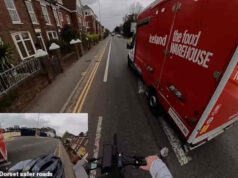

Bike Trekking with Karl recently released a video titled “Cyclists Need Number Plates! Is This Getting Ridiculous Or Could It Work??” It’s an energetic attempt to explore whether cycle registration could be introduced in the UK. Karl covers a lot of ground: CCTV, mobile phone tracking, Dutch traffic lights, Vision Zero, casualty statistics, and the idea that cyclists “get an easy ride.” But for all the topics he touches, he never addresses the one thing that actually decides the issue. He didn’t research the legal framework of the very subject he’s talking about.
Karl opens by asking, “What’s wrong with having a licence plate on the back of your bike?” and promises to give the idea “a real fair look.” He then asks, “What would it actually take to get registration plates onto bicycles?” and immediately jumps into admin: “We’d need a national database, registration for millions of bikes, a way to easily identify riders, enforcement, and ongoing administration.” He claims the Department for Transport has repeatedly concluded it’s too expensive. But that’s not what the DfT has ever said. The DfT’s actual position is that cycle licensing would be disproportionate, bureaucratic, ineffective, and not justified by safety data. They never said the UK “can’t afford it.” They said it isn’t worth doing because it doesn’t solve a real problem.
But even that isn’t the real barrier. The real barrier is that cycles sit inside a Common Law right that cannot be licensed without Parliament explicitly abolishing it. That point never appears in the video.
Cycles are legally classed as carriages. Carriages have a Common Law right of passage that goes back to the 13th century. It is one of the oldest rights in English law. That right cannot be licensed, charged for, or made conditional unless Parliament uses explicit wording in primary legislation to extinguish it. Not regulate it. Not modify it indirectly. Abolish it. And not just for bikes, but for all carriages. That is why the Attorney General rejected cycle‑licensing proposals when ministers floated them. It wasn’t cost. It wasn’t enforcement. It wasn’t technology. It was the constitution.
Karl never mentions this. Not once.
Instead, he tries to build a case based on behaviour. He notes that car occupants account for “70,000 casualties per year,” pedestrians for “19,000,” and cyclists for “14,500.” He then says “95 to 99% of the casualties… were caused by motor vehicles.” That’s accurate, but irrelevant to the legal question. He then compares enforcement numbers: “Around about 49 cyclists are prosecuted for serious cycling offences,” versus “hundreds of thousands, if not millions of motorists.” Again, true, but irrelevant to whether cycles can be licensed.
Karl then argues that because “cyclists are so fluid they can hop from bike to bike,” the system would need to track pedestrians, too. He even imagines a scenario where a pedestrian “popping their registration number around their neck” becomes necessary. This is a false equivalence created by skipping the legal categories. Pedestrians aren’t carriages. But pedestrians also have the Common Law right to pass and repass.
From there, the video moves into a dystopian direction. Karl says, “Your mobile phone is always transmitting your data,” and suggests that the only workable solution would be “an app that tracks everyone’s whereabouts” combined with AI‑enabled CCTV. He references the COVID‑19 app and surveillance systems in China, warning that “we are now moving into the realms of mass surveillance.” But this entire section is built on a false premise. Cycle licensing isn’t impossible because it requires surveillance. It’s impossible because it requires abolishing a medieval Common Law right.
Karl then pivots to design. He shows cyclists riding through a red light and says, “I’m not encouraging anyone to ever do that,” before explaining how the Netherlands uses sensors to change lights automatically. He praises Vision Zero, noting that some cities have achieved “zero fatalities in one year.” He argues that “bad design promotes bad behaviour” and that better design “has been shown to reduce injuries and fatalities by upwards of 50%.” All of this is valid urban‑planning commentary, but none of it answers the question he set out to address.
He also argues that registration doesn’t stop bad behaviour, pointing out that “nearly 50% of motorists are still exceeding the speed limits” despite cameras, fines, and penalty points. He notes that many red‑light runners are “repeat offenders” even after being caught. This is true, but again irrelevant to the legal structure. Whether registration works or not has nothing to do with whether cycles can legally be registered.
We added a post in the comments pointing out that cycling is a common law right. Karl replied to our post :
“I get the common law point, but Parliament overrides or modifies common law all the time. The Road Traffic Act introduced licences and compulsory insurance, the Highways Act places restrictions on how the highway can be used, and laws like the Health Act have limited everyday freedoms in public spaces. So it’s not ‘legally impossible’, it’s a question of whether it would actually be effective.”
This sounds confident, but it’s based on a misunderstanding of how Common Law rights work. Parliament can override Common Law, but only when it uses explicit wording to extinguish a right. The Road Traffic Act didn’t remove a Common Law right from motorists because motorists never had one. Driving a mechanically propelled vehicle has always been a statutory activity. That’s why early cars legally required a man walking in front with a red flag. If motorists had a Common Law right to drive, Parliament couldn’t have imposed that.
Karl’s examples don’t support his point. The Highways Act regulates behaviour on the highway, but it doesn’t extinguish the right of passage. The Health Act restricted smoking in enclosed public spaces, but smoking was never a Common Law right. These are statutory restrictions on statutory or social activities. None of them involved abolishing a Common Law right that predates Parliament.
The right of passage for carriages is different. It is a Common Law right that Parliament must explicitly abolish if it wants to license it. Not regulate it. Not modify it indirectly. Abolish it. And abolishing it for cycles means abolishing it for all carriages, because the right applies to the category, not the object. That includes horse‑drawn vehicles, handcarts, and anything else legally defined as a carriage. Parliament has never attempted this because it would be a constitutional upheaval far beyond the scope of cycle licensing.
Karl finishes his comment by saying, “So it’s not legally impossible, it’s a question of whether it would actually be effective.” But it is legally impossible unless Parliament chooses to abolish a medieval Common Law right for every carriage on the road. That is the threshold. That is the barrier. And that is why the Attorney General shut the idea down when ministers floated it.
Karl’s reply repeats the same problem as the video: he researched everything except the subject he was talking about.