
Debate continues over whether cycling infrastructure is contributing to the decline of the British high street, with new research suggesting the issue is more complex than local disputes imply. While some traders argue that cycle lanes and traffic restrictions have reduced passing trade, national data points to wider structural changes in retail that began long before active‑travel schemes were introduced.
A study by Dr Rachel Aldred of Westminster University, published through the Active Travel Academy, found that pedestrian‑ and cycle‑friendly street designs tend to increase footfall rather than reduce it. Her analysis of schemes in London and Waltham Forest showed that removing through‑traffic and improving public space led to more walking and cycling trips, with many businesses reporting higher takings. Aldred said the evidence “does not support the idea that car‑dominated streets are essential for retail vitality”.
Transport for London reached similar conclusions. A 2018 study led by economist Richard Dilks found that people arriving on foot, by bus or by bike spend more per month than those arriving by car. Retail performance on streets with new cycle lanes grew faster than the borough average. Dilks said the data showed “a consistent pattern: when streets become safer and more pleasant, people stay longer and spend more”.
Retail analysts argue that the decline of many high streets predates cycling schemes by at least a decade. Professor Cathy Parker of Manchester Metropolitan University, who leads the High Streets Task Force, said online retail, rising rents and out‑of‑town shopping centres have had a far greater impact than changes to road layouts. Parker said that while construction works can cause short‑term disruption, long‑term retail performance is “overwhelmingly shaped by national economic trends, not transport mode share”.
The British Retail Consortium has also pointed to online retail as the dominant factor. Its chief economist, Harvir Dhillon, said internet shopping now accounts for more than a quarter of all retail sales, a shift that has “reshaped consumer behaviour far more dramatically than any local transport intervention”.
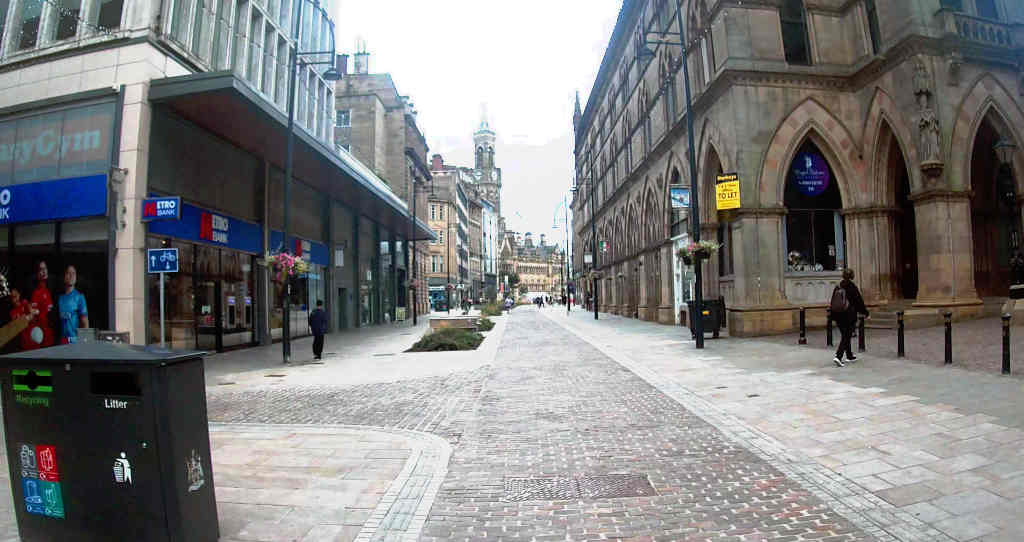
In West Yorkshire, contrasting approaches in Bradford and Leeds have brought the debate into sharper focus. Bradford has recently completed a major pedestrianisation scheme in the city centre, funded through the Transforming Cities Fund, which has removed through‑traffic from key streets and introduced new cycling facilities. The changes have coincided with the rollout of the Beryl e‑bike hire scheme, launched as part of the city’s emissions‑reduction strategy. Early usage data reported by the council and the operator show strong uptake, with hundreds of trips recorded in the first week. Bradford Council has said the redesigned streets are intended to create a more welcoming environment for walking, cycling and public space, with early footfall figures indicating increased activity in the pedestrianised areas.
Leeds City Council has taken a different approach. The authority is pursuing a Public Space Protection Order that would require cyclists to dismount in pedestrianised shopping streets such as Briggate and Commercial Street during core retail hours. Supporters argue the measure is needed to address anti‑social behaviour, while critics say it conflicts with the city’s investment in cycle routes leading into the centre and risks discouraging active travel.
Accessibility remains a key concern in the debate. Disability rights campaigner Fazilet Hadi of Disability Rights UK said that poorly designed schemes can create barriers, but stressed that “cycle lanes themselves are not the problem — the issue is whether councils provide Blue Badge bays, drop‑off points and step‑free access”. Hadi argued that accessibility “should be built into every scheme from the start”, rather than used as a reason to maintain high‑traffic streets.
International evidence mirrors the UK findings. Studies by former New York City transport commissioner Janette Sadik‑Khan and urban economist Donald Shoup at UCLA show that pedestrianisation and protected cycle lanes tend to boost local business performance when paired with effective parking management and improved public space.
Despite the growing body of research, the political debate remains polarised. Critics of cycling schemes often cite local shop closures as proof of harm, while supporters argue that these closures reflect national economic pressures rather than the presence of cycle lanes. With councils under pressure to revitalise town centres, the question of how streets should be designed is likely to remain contentious.
What the evidence does show, according to researchers such as Aldred, Parker and Dilks, is that the health of the high street is shaped by long‑term economic forces, not by whether a road has a cycle lane. As British towns continue to adapt to changing shopping habits, the role of street design — and the emotions it provokes — is set to remain part of the national conversation.