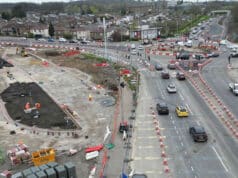
Floating bus stops are dangerous. The claim appears constantly in headlines, in disability campaign literature, and in parliamentary debate. It is stated with confidence. The recorded data does not support it. The reasons why that data falls short are part of the story. So is what the government has actually done.
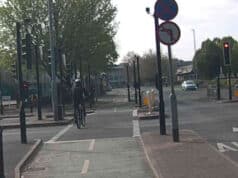
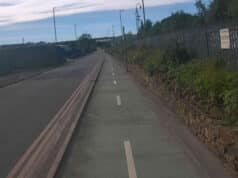
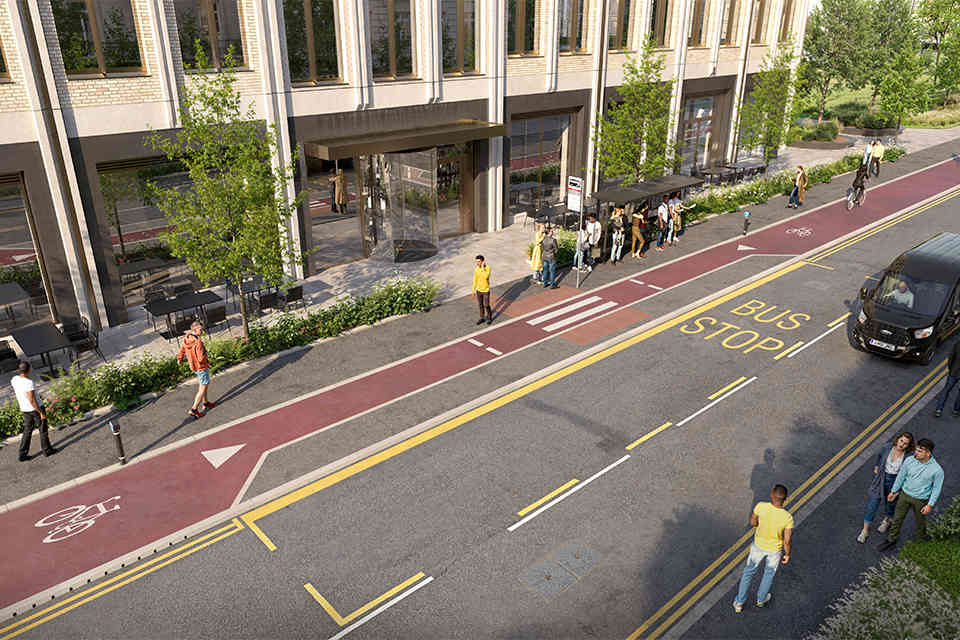
Start with the numbers. Transport for London operates 164 bus stop bypasses across the capital — a design where a cycle track passes behind a raised island from which passengers board and alight. TfL’s 2024 safety review of those stops, covering three years from 2020 to 2022, recorded six pedestrian injuries in collisions with cyclists or e-scooter riders. Three were serious. None were fatal. TfL placed this against 11,400 pedestrian injuries caused by motor vehicles in London over the same period. The national picture is consistent. Department for Transport figures show that across Great Britain, in all circumstances and not just at floating bus stops, fewer than four pedestrians per year on average are killed in collisions with cyclists. Of 448 pedestrians killed by vehicles in 2016, three involved bicycles. Motor vehicles account for 99 per cent of pedestrian fatalities on pavements and verges. There are no recorded fatalities at floating bus stops anywhere in the UK.
Those numbers matter. Six injuries over three years across 164 busy urban locations is not carnage. Anyone claiming that floating bus stops produce significant casualties needs to account for them.
Why the data is limited
The case for treating those figures with caution comes from three directions. First, the review period runs from 2020 to 2022, covering two full years of COVID-19 restrictions during which public transport use collapsed. The figures do not reflect normal operating conditions. TfL has not published comparable data for the post-pandemic period.
Second, TfL’s own design audit found that 56 of its 164 bus stop bypasses — 34 per cent — varied significantly from TfL’s own best practice design guidance. Defects included the absence of crossing markings at the cycle track crossing point, incorrect tactile paving, and bus stop islands too narrow for safe use. Low injury figures at partly non-compliant stops during a period of reduced use do not establish that the design is safe.
The third limitation is one that the statistics cannot capture. The RNIB survey of nearly 1,200 blind and partially sighted people, conducted in February 2025, found that 49 per cent of those who had encountered bus stop bypass designs had made fewer journeys to avoid them. A person who decides not to use the bus does not appear in any injury record. Near-misses are not counted. The six-injury figure describes a floor, not a ceiling.
What the government’s response reveals
What the data cannot settle is whether the current situation is stable, whether it reflects good design or luck or reduced footfall, and whether it will hold as cycling volumes increase. Those questions are answered not by the injury data but by what the government has actually done. On 20 November 2025, the Minister for Roads and Buses, Simon Lightwood, wrote to all local authorities in England asking them to pause the installation of a specific floating bus stop design. On 26 January 2026, the first statutory guidance on floating bus stop provision and design was published under section 31 of the Bus Services Act 2025. Governments do not pause design types and issue statutory guidance because the data shows no problem. The pause and the guidance are an official acknowledgement that the conditions for harm are present even where recorded harm is low.
“Floating bus stop” is not a single design, and that matters for understanding what the government paused and why. Since the Bus Services Act 2025 gave the term a statutory definition, it covers all configurations where a cycle track and bus stop intersect. Within that sit designs with very different risk profiles. The bus stop bypass places the bus shelter and flag on a raised footway island, with the cycle track passing behind it. Passengers cross the cycle track — typically at a marked crossing point — to reach the island. The shared-use bus boarder is different: there is no island, and passengers board and alight directly from or into the cycle track. The government’s pause covers the shared-use bus boarder. It does not cover the bus stop bypass. The January 2026 statutory guidance confirms this distinction. The six-injury figure relates to bus stop bypasses. The pause relates to shared-use bus boarders. These are different things, and the failure to distinguish them has produced a debate that talks past itself.
The crossing and the Highway Code
The crossing point at a bus stop bypass — where passengers cross the cycle track to reach the island — raises a specific regulatory question. Most are marked with black and white stripes. The assumption in much commentary is that these are zebra crossings carrying the same rules as a road crossing. The regulatory picture is more complicated.
Schedule 14 of the Traffic Signs Regulations and General Directions 2016 addresses this directly. Paragraph 25(2) disapplies the requirement for a controlled area — the zig-zag markings — in any part of a carriageway that is a cycle track. Paragraph 25(3) goes further: where a zebra crossing only crosses a cycle track, the Belisha beacon is not required. Together, these provisions mean that a zebra crossing across a cycle track can lawfully exist without beacons and without zig-zags. It is still, in law, a zebra crossing. One qualification matters: the beacon exemption under paragraph 25(3) applies only where the crossing is confined entirely to the cycle track. Where a specific stop’s crossing geometry extends beyond that — across a footway section, for instance — a beacon may be legally required. Whether individual crossings meet that test depends on their geometry, which varies between installations.
The Highway Code does not mention this crossing type anywhere. The consequences run in a clear sequence. Rule 19 describes zebra crossings as having flashing beacons. The only depiction in the Highway Code shows the full beacon-and-zig-zag format. A cyclist who has read the Highway Code has no basis to recognise painted stripes across a cycle track as a zebra crossing, because the code has never described or illustrated that crossing type.
Rule 191’s MUST NOT obligations — prohibiting parking and overtaking — are tied to the zig-zag controlled area. At a floating bus stop cycle track crossing, there are no zig-zags. The protective zone that surrounds a standard road zebra crossing does not exist here.
Rule 195 sets out approach obligations at zebra crossings: look out for pedestrians waiting to cross, be ready to slow down or stop, give way to those waiting, and MUST give way once a pedestrian has stepped onto the crossing. These obligations assume a road user who can identify the crossing in advance — on a standard road crossing, the beacon and zig-zag zone achieve that at distance. At a cycle track crossing with only painted stripes, those advance cues are absent. Rule 195 is also addressed to drivers and motor vehicle users. It is not addressed to cyclists. Nowhere in Rules 59 to 82 — the section of the Highway Code written specifically for cyclists — is there any approach guidance for any zebra crossing, beaconed or otherwise.
The only operative rule for cyclists at these crossings is Rule H2’s MUST give way obligation, which activates once a pedestrian has moved onto the crossing. This obligation is reactive — triggered after a pedestrian has already stepped out — not an advance approach obligation. The Highway Code gives cyclists a legal obligation at a crossing type the code never describes, never illustrates, provides no approach guidance for, and whose identifying physical features have been specifically exempted in legislation that the code does not mention.
The January 2026 statutory guidance mandates give way signage at crossing points. That is the right direction. A sign at the crossing addresses the cyclist who has already arrived. It does not address the cyclist who has never encountered this crossing type and has no Highway Code framework for understanding what the markings mean.
The advisory rules that apply to cyclists in this environment do not carry direct legal force but point in the same direction. Rule H1 establishes that those in charge of vehicles that can cause the greatest harm bear the greatest responsibility. Between a cyclist and a pedestrian, that responsibility falls on the cyclist. Rule 63 advises cyclists to slow down when necessary, give an audible warning of their approach, and not pass pedestrians closely or at high speed — particularly from behind, given that pedestrians may be deaf, blind, or partially sighted. Rule 65 advises watching out for people getting on or off a bus. None of these carry the legal force of Rule H2’s MUST. All of them point toward the same conduct: slow, watch for passengers, be prepared to stop.
Rule 13, in the pedestrian section, establishes that pedestrians should take care not to obstruct or endanger cyclists and should remain aware of their environment. These are advisory obligations. A passenger who steps into a live cycle track without looking has not met the standard the Highway Code sets for their own conduct. The obligations at a bus stop bypass do not fall exclusively on cyclists, though the only rule carrying legal force at the crossing itself is the one addressed to them.
Leeds and the compliance question
Leeds City Council told the BBC that it operated 131 floating stops across the council area. The figure has likely grown — A660 works on installing further stops, which remained ongoing as of June 2025. When the council announced alterations to three stops on the A660 in Headingley following complaints from road users, its spokesperson explained that the original designs had been compliant with government guidance at the time of installation. That guidance was LTN 1/20, now superseded by the January 2026 statutory guidance. TfL’s own audit found that more than a third of its stops deviated from design standards under the same pre-2026 framework. Compliance with superseded guidance is not evidence of safety. It is evidence that the standard has moved on.
The claim that floating bus stops are dangerous is not supported by the recorded injury data. The claim that they are safe is not supported either. A 34 per cent significant design failure rate at the authority with the most experience of them, a pause on one design type from government, new statutory guidance, ongoing Active Travel England research not due until 2027, a Highway Code that describes and illustrates zebra crossings only in their beaconed form while providing cyclists with no approach guidance for the unbeaconed version required at bus stop bypasses, and nearly half of blind and partially sighted people making fewer journeys to avoid them: these are not the indicators of a design that is working well.
The bus stop bypass, correctly built to current standards — adequate island width, correct tactile paving, properly constituted crossing with give way signage — can operate with a low injury rate. The bus stop bypass as actually built and actually used, at scale, across the country, is a different matter. The government knows which of those two it is. That is why it has issued a pause and statutory guidance.