There is a persistent myth circulating on social media that cycle paths and shared routes in the UK have specific speed limits for cyclists. Numbers such as 10mph, 12mph and 18mph are repeated with confidence, often presented as if they come from official guidance. They don’t. None of these figures appear in UK law, and none of them appear in the government’s design standards for cycling infrastructure.
Those standards come from a document called Local Transport Note 1/20. Published in July 2020 by the Department for Transport as part of the government’s “Gear Change” strategy, it replaced older, inconsistent guidance and gave councils a single national framework for designing cycle routes. The document was written by transport engineers and policy specialists, and its purpose is to set out how safe, accessible cycling infrastructure should be built. It covers width, junction design, gradients, visibility, surface quality and accessibility for adapted cycles. It is a technical design manual for planners and engineers — not a rulebook for cyclists.
Despite this, the idea of cyclist speed limits continues to spread online. A recent Facebook thread shows how widespread — and inconsistent — the claims have become. One user confidently stated:
“Shared areas 10mph, cycle paths 18mph, cycle lanes no limit.”
Another insisted:
“Off‑road shared paths are 12mph.”
Others argued over whether 18mph applied to cycle lanes or cycle paths, with one commenter saying:
“He stated 18mph for cycle lanes – I didn’t. I stated 18mph for cycle paths. They’re not the same thing.”
These claims contradict each other, and they contradict the actual guidance.
Local Transport Note 1/20 contains no mph values at all. It does not set speed limits for cyclists, advisory or otherwise. It does not define maximum speeds for cycle paths, shared paths or cycle lanes. The numbers quoted online do not appear anywhere in the document.
The confusion usually comes from a technical term in the guidance: design speed. This is not a rule for cyclists. It is a planning parameter used by engineers to calculate stopping distances, corner radii and forward visibility. It is not a target speed, not a maximum speed and not an advisory limit. Designers choose an appropriate design speed based on context; the document does not prescribe one, and it does not impose one on cyclists.
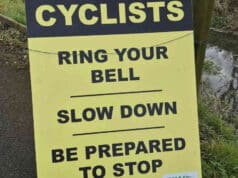
Speed limits themselves apply only to motor vehicles. Councils cannot create advisory speed limits for cyclists, and signs such as “10mph” on shared paths have no legal meaning. A claim that a cycle path is “18mph” has no legal meaning. A claim that a cycle lane is “20mph” has no legal meaning.
The Facebook thread doesn’t reveal hidden rules or forgotten guidance. It shows how easily misinformation spreads when numbers are repeated without checking their source. The only place these figures exist is online, where they are passed from one person to another until they sound authoritative. The guidance itself never said them.