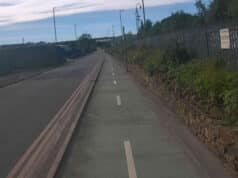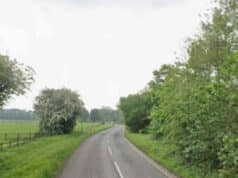
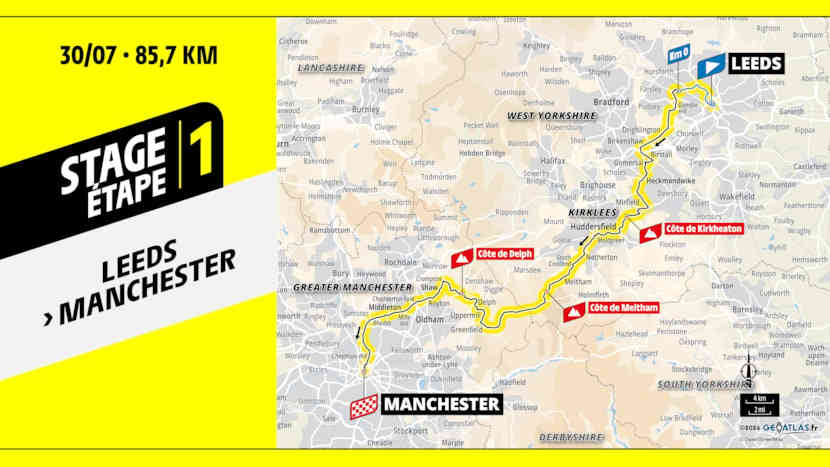
The Tour de France Femmes will begin in Britain for the first time in 2027, and West Yorkshire will shape the opening stage from Leeds to Manchester in ways that will matter far more than the profile suggests. The Pennine climbs come later, but the West Yorkshire section is where the race will be at its most compressed, most technical and most vulnerable to early splits. These are the same roads local riders use every week, and the same awkward cambers, narrow corridors and stop‑start rhythm that define riding in this part of the country will define the first hour of the Tour.
Race director Marion Rousse summed up the significance of bringing the race to Britain, saying that the United Kingdom has already shown its passion for the Tour, and that these stages will once again showcase the energy of the crowds, the beauty of the landscapes and the growing importance of women’s cycling on the world stage. West Yorkshire will be the first test of that, and it will be a real one.
The race rolls out from The Headrow before heading west through the city. Once the flag drops near Farnley, the peloton immediately hits the kind of terrain that punishes poor positioning. The drag toward Gildersome is not steep, but it is exposed and full of street furniture. Teams will already be fighting to keep their leaders out of trouble, because the roads only tighten from here.
The descent into Birstall is fast and messy, with multiple roundabouts and a downhill that encourages over‑commitment. Crowds will be heavy here, and the bunch will be stretched before it even reaches the Spen Valley. Once the race enters Birkenshaw, Cleckheaton, Heckmondwike and Liversedge, the character of the stage becomes unmistakably West Yorkshire. These towns form a continuous corridor of bends, junctions and short ramps that force constant braking and re‑accelerating. There is no rhythm, no long straight and no easy way to move up. A GC leader caught behind a split here can lose 30 seconds without ever crashing.
Cleckheaton town centre is one of the most technical sections of the entire day. The road narrows, the surface is inconsistent and the bends come in quick succession. Heckmondwike offers no respite, with a long sequence of bends that keep the peloton strung out. Liversedge is slightly more open, but the surface remains patchy and the bunch will still be stretched. This entire section is likely to be ridden in a long line, with the strongest teams controlling the front and weaker squads simply trying to survive.
Mirfield finally gives the peloton some breathing room, but it introduces a new threat. The run toward Cooper Bridge is exposed enough that a crosswind could split the race. If the wind direction is right, this is where the first meaningful gaps of the Tour could appear. Teams with strong classics riders will be alert, because a well‑timed acceleration here could put rivals on the back foot before the Pennines even begin.
After Cooper Bridge the race leaves West Yorkshire and heads toward Saddleworth, where the climbing starts and the stage takes on a more traditional Grand Départ profile. But the damage, if any, will already have been done. West Yorkshire’s contribution is not a single decisive climb but the cumulative stress of 50 kilometres of technical, high‑pressure riding where positioning is everything and mistakes are punished immediately.
British representation at the 2027 Tour de France Femmes is expected to be deeper and more competitive than at any previous edition, and several riders are on clear pathways toward meaningful roles in Leeds.
Cat Ferguson is the most obvious name. By 2027, she will be 20, already established at the WorldTour level, and almost certainly a protected rider for Movistar in hilly one‑day races and medium‑mountain stages. Her junior record, her rapid adaptation to elite racing, and Movistar’s long‑term investment in her make her a near‑certainty for selection. A Grand Départ on British roads suits her perfectly: technical terrain, short climbs, and the kind of positional intensity she has already shown she can handle.
Anna Henderson is another realistic starter. Her strengths — crosswinds, technical urban sections, and high‑speed lead‑outs — align directly with what Stage 1 demands. Visma–Lease a Bike relies on her as a road captain and classics‑style engine, and she is exactly the type of rider teams use to keep GC leaders out of trouble on a day like Leeds–Manchester. If she is fit, she starts.
Pfeiffer Georgi should also be considered a strong candidate. She is one of Britain’s most tactically intelligent riders, excels in narrow‑road positioning, and is a proven asset in chaotic stages. dsm–firmenich PostNL build their Tour squads around riders who can control the front of the race, and Georgi fits that profile better than almost anyone in the British system.
Lizzie Deignan is the wildcard. If she continues racing into 2027, a Leeds Grand Départ would be a defining moment in the final phase of her career. Lidl–Trek would not bring her for sentiment — they would bring her because she remains one of the best riders in the world at reading a race, calming a team, and handling the exact kind of terrain West Yorkshire offers. Her participation depends entirely on her own timeline, not her ability.
Other possible British starters include Abi Smith, who has the engine for long, attritional days and is improving year on year, and Millie Couzens, who is developing into a reliable all‑rounder with strong positioning instincts. Neither is guaranteed, but both are on upward trajectories that could put them in contention.
This is the realistic British picture: not vague optimism, but a set of riders with clear roles, clear strengths, and clear reasons why a Leeds start makes sense for them.
For West Yorkshire, the significance is clear. The roads that thousands of local cyclists ride every week will host the world’s best riders, and the region’s unique mix of urban density, technical geometry and exposed valleys will play a genuine role in shaping the opening chapter of the 2027 Tour de France Femmes. It is not a ceremonial procession. It is a real test, and one the peloton will need to survive before the race even reaches the Pennines.